Construction Services
Paver installation in Phoenix, built for the desert it lives in
Patios, walkways, driveways, and pool decking over an engineered base that handles monsoon water and Arizona heat.
Most paver failures in Phoenix have nothing to do with the pavers. They come from what's underneath: a thin base, poor compaction, and grading that ignores where monsoon water actually wants to go. The stone on top is the easy part.
State48 designs and installs paver patios, walkways, driveways, and pool decking across the Phoenix metro. Licensed, bonded, and insured, AZ ROC #344120.
What we build with pavers
Patios and outdoor living floors
The foundation of the backyard: dining areas, lounge zones, fire pit surrounds, and the transitions between them. Laid over an engineered base with borders and patterns scaled to the space, not to a catalog page.
Walkways and courtyards
The connective tissue of a landscape design. A walkway sets the pace of arrival, which is why we treat front courtyards and entry paths as design work, not flatwork.
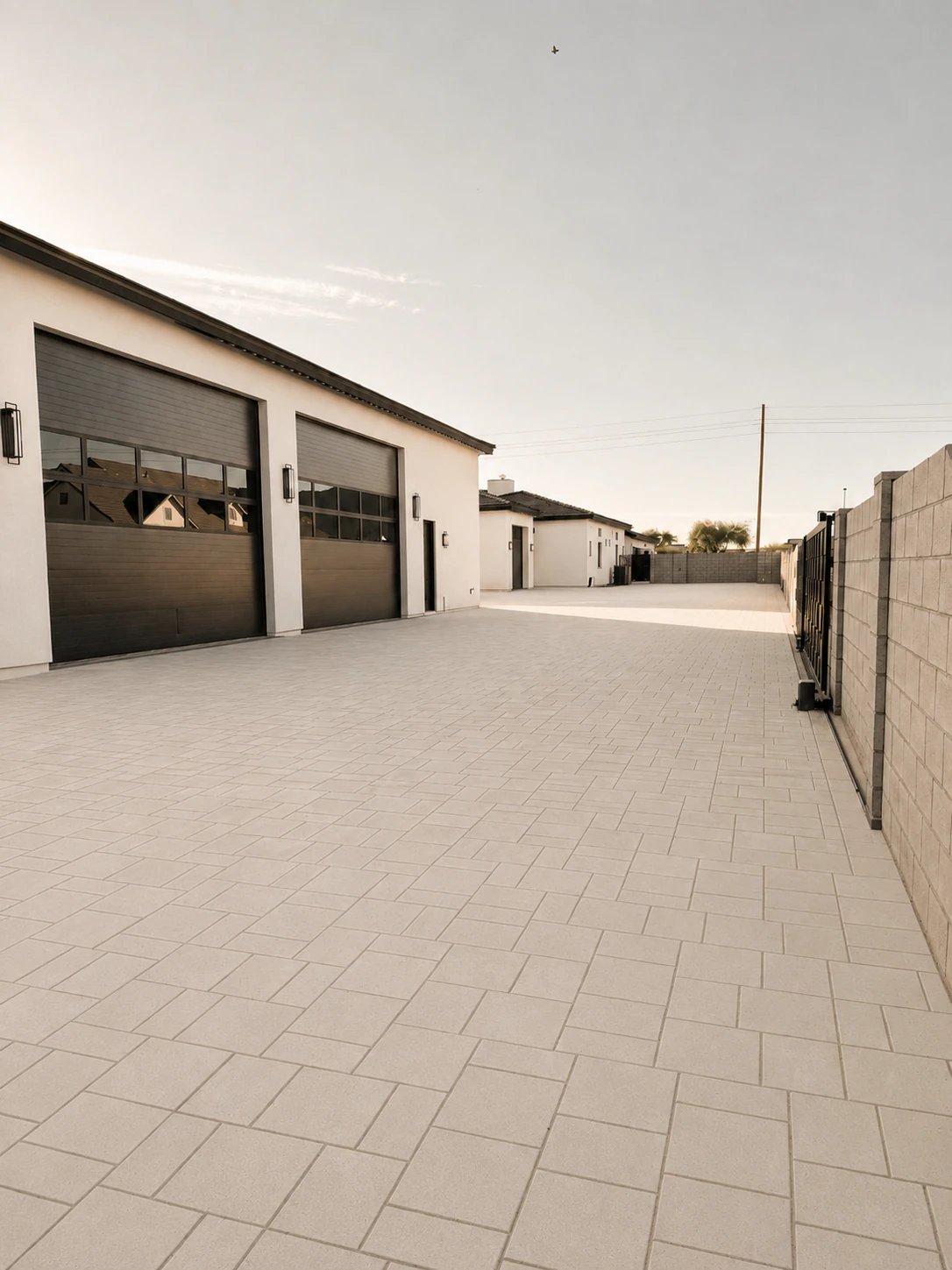
Driveways and motor courts
Driveways carry vehicle loads, so they get thicker pavers and a deeper compacted base than a patio. Done right, a paver motor court is the strongest first impression a home can make from the street.
Pool decking
Decking, coping, and the hardscape around the water are our work. When a project includes structural pool construction or remodeling, that scope runs through our licensed pool partner, and State48 designs and builds everything around it so the finished space reads as one design. See our pool decking services.
Paver materials for the Phoenix climate
Concrete pavers
The workhorse. Consistent sizing, the widest range of colors and formats, strong value per square foot, and simple unit-by-unit repair if one ever cracks. Lighter colors run cooler underfoot than charcoal tones, which matters here more than anywhere.
Travertine
A natural stone in ivory, cream, and walnut tones that stays noticeably cooler in direct sun, which is why it dominates high-end pool decks in the Valley. It costs more than concrete and wants sealing in the right applications. Full breakdown on our travertine pavers page.
Flagstone
Irregular natural stone for a more organic, estate feel. It sits at the top of the price range: Angi's 2026 Phoenix data puts flagstone and other high-end materials as high as $52 per square foot installed (Angi, April 2026).
What pavers cost in Phoenix
Angi's Phoenix pricing guide, updated April 2026, puts paver installation at $8 to $26 per square foot installed, with most Phoenix projects landing between $2,479 and $7,231 and an average around $3,925 (Angi, "How Much Does a Paver Patio Cost in Phoenix, AZ?", April 2026).
By material, Angi's 2026 figures run $8 to $16 per square foot for concrete pavers, $10 to $21 for brick, and $16 to $51 for natural stone, installed.
Treat all of these as planning ranges, not quotes. Site access, demolition, grading, drainage work, and pattern complexity move real numbers meaningfully, which is why we price from a site walk and a design, never from a chart. For the full breakdown of what drives price up or down, read our Phoenix paver patio cost guide.
Three things Phoenix does to hardscape
Heat
Surface color decides barefoot comfort. Pale stone and light concrete tones reflect sun; dark surfaces store it and give it back all evening. If the space is for bare feet, material and color selection is a comfort decision before it is an aesthetic one.
Monsoon water
A paver system on a compacted aggregate base with sand joints handles storm water better than a monolithic slab, but only if the grading moves water away from the house and the pool. The City of Phoenix requires a permit when a patio affects water drainage, attaches to the home, or exceeds 200 square feet, with permits running $100 to $300 (Angi, April 2026). We design the drainage plan before the pattern.
HOA design review
Much of our work sits in communities with architectural review: Scottsdale, Paradise Valley, DC Ranch, Silverleaf, and the newer Queen Creek and Gilbert developments. Visible hardscape, and driveways especially, usually needs approval. We prepare the drawings and material specs your review board asks for.
The part you can't see decides how long it lasts
Excavation depth, base material, compaction in lifts, edge restraint, joint sand. None of it photographs well and all of it determines whether the surface is still flat in year ten. Sunken corners and wavy driveways are base failures, not paver failures.
Ask any contractor you interview to describe their base spec for your soil before they show you a color catalog. The answer tells you who you're hiring.
Common Questions
Paver FAQs
How much does it cost to install pavers in Phoenix?
How much should a 20x20 paver patio cost?
Is it cheaper to lay concrete or pavers?
Do I need a permit for a paver patio in Phoenix?
Do pavers add value to a Phoenix home?
Go deeper
See it before we build it
Every State48 project starts with a design consultation and 3D renderings, so you approve the finished space before anything gets demolished.
Request your design consultation